Why more findings do not mean a better documentation review
How to assess a documentation review report: distinguish material errors from repetition, verify the evidence, set priorities, and obtain a substantive response from the designer.
You have received a project review report. It contains many pages, tables, and findings. At first glance, it looks thorough: a short report might arouse suspicion, while a long one inspires confidence. Yet the first few items raise a question: which of them actually require a correction?
Consider an illustrative situation. One inconsistency between a drawing and a specification is described in several places. Alongside it are questions about documents the reviewer never received and general wishes to “clarify the design solution.” The list is long, but it contains fewer independent problems than records. There may be a material error among them, but it still needs to be found in the stream of similar wording.
This is an invented example, not a review of a particular customer’s project. It shows why counting findings is a poor way to assess quality. A long list can reflect many defects. It can also reflect repetition, missing information, or overly broad questions. Length alone does not distinguish those cases.
A more useful criterion for the customer is whether the report helps make a decision about the documentation. Can you open the source location? Is it clear what is being compared? Is there a basis for requesting a correction? After the designer’s response, can you verify that the question was resolved?
This article explains how to read such a report. The purpose is not to accept or reject every AI conclusion in advance, but to separate workable findings from records that still need evidence.
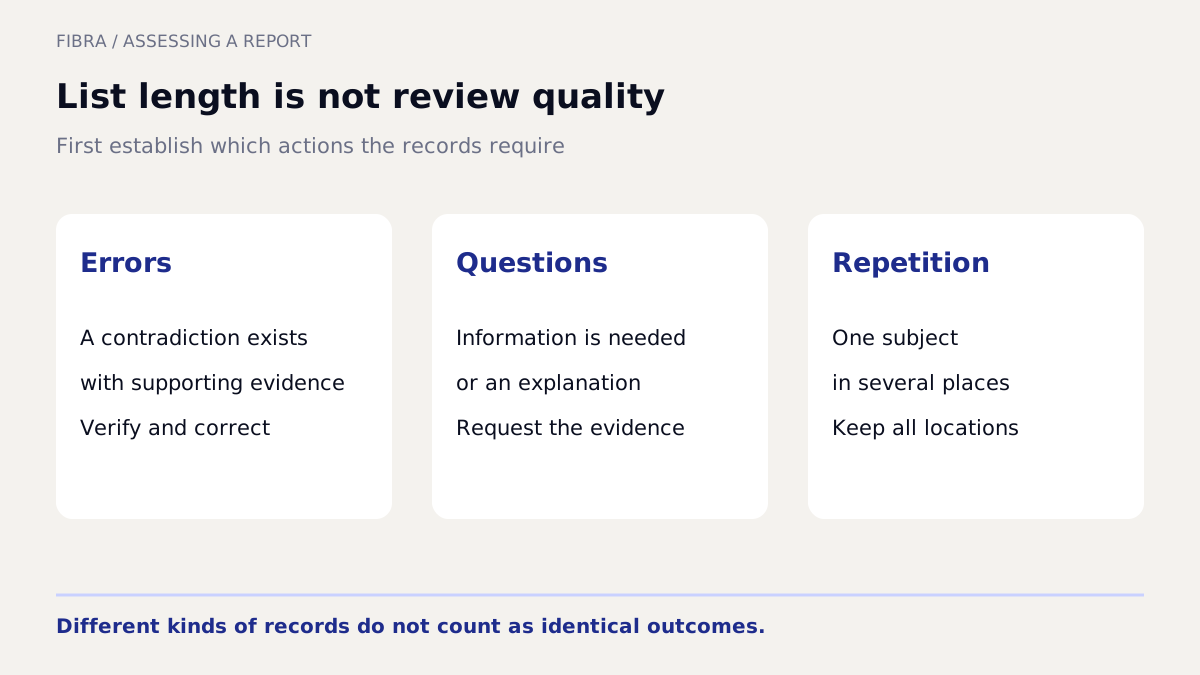
A useful report item is a question supported by verifiable evidence, not merely a row in a list.
1. Establish what was reviewed
Before reading the findings, look at the review’s subject. Which discipline was supplied, which files belong to the set, and which revision do they represent? If an old plan is being discussed alongside a new specification, the discrepancy may come from the set’s composition rather than the design solution.
The boundaries matter too. A reviewer may have received one discipline without related documents. A question answered elsewhere cannot automatically be treated as an established error. The report should let you distinguish a contradiction found from a comparison that could not be completed with the available material.
For example, “no basis found for the quantity” does not yet say that the quantity is wrong. The calculation might be absent from the supplied set; a source dimension might be hard to read; two incompatible values might exist; or the reviewer might have failed to establish the relationship. Those situations call for different next steps.
Do not demand an immediate correction for every question. Sometimes a missing sheet or an explanation is needed first. The opposite extreme is also unhelpful: not every question can be dismissed as insufficient information when the supplied documents contain a direct contradiction.
Start by preserving the set to which the report relates and its contents list. When a new revision arrives, do not silently replace the source documents. Otherwise a discussion about a conclusion quickly becomes a dispute about who saw which version.
We discuss why the amount supplied does not itself establish review depth in the article about the scope of one run. The practical point here is to assess a particular review of a particular set, not a promise that “we looked at everything.”
2. Check the evidence, not the persuasiveness of the wording
A good finding has a location you can open and a relationship you can check. “Material breach” or “critical discrepancy” replaces neither of those things. Calm, careful wording can still be unsupported, while an emphatic statement can describe a real problem.
Start with the address: file, sheet, item, or clause. Find what the source actually states. Then establish the other side of the comparison: another sheet, a specification row, source dimensions, or a document condition. Without that second side, the discrepancy may still be a hypothesis.
For an illustrative example, take two components with the same mark on a plan and one in the specification. That is a concrete question. But first check that the records concern the same subject, revision, and scope of work. If one component belongs to another item, the difference in numbers alone does not establish an error.
For a quantity finding, seeing the basis of the calculation is more useful than receiving only the final total. Which source values were used? What units do they have? Do the dimensions belong to the component being checked? A value copied from the disputed row is not independent confirmation of that row.
A finding about a regulatory requirement needs verification of the source and its applicability. Naming a document and confidently saying “non-compliant” does not establish that the clause exists or applies to your case. We have already examined the risk of citing a non-existent clause.
A workable criterion is simple: another specialist should be able to reconstruct the finding from the places cited. The detailed standard of source, quotation, and calculation explains this verifiability. It is more useful in discussion with the designer than arguing over how convincing the AI sounds.
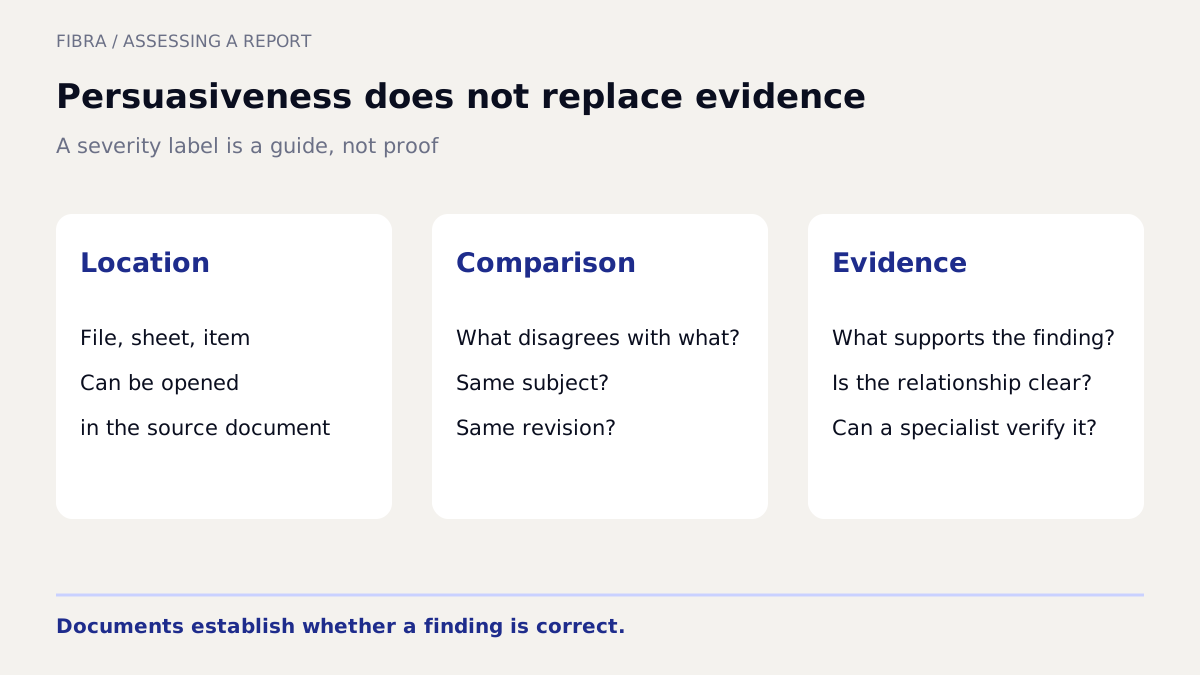
A severity label helps orientation. Documents establish whether the conclusion is correct.
3. Separate errors, questions, and repetition
A report can contain records of different kinds. An error is an established contradiction or an incorrect value supported by evidence. A question still needs information or an explanation. A repetition describes a subject already raised. They should not be counted as identical outcomes.
A question can be useful in its own right. If the customer has not received an appendix on which a decision depends, that is a reason to request it. Requesting a document and demanding a design correction are different actions. Mixing them can produce a long list of complaints, many of which are really requests to complete the set.
Repetition is not always obvious either. One cause may appear on several sheets. Simply deleting similar records could lose an important correction location. It is more useful to group the shared question while preserving the affected locations: what needs reconciliation, and where should the consequences be checked?
Suppose a component’s mark changed, but the old designation remains in a table and a note. That may be one correction subject with several addresses. If similar wording concerns different components, the questions remain separate. Similar text does not prove that the problems are identical.
General wishes need clarification. “Improve consistency” or “clarify the design solution” is not a workable finding until the location and subject are named. Ask which statements are incompatible or precisely what information is needed to answer the question.
After that reading, the list may become shorter. This does not establish that the review was poor: some records may have become one more precise question, others a request for source information. The aim is not to shorten a list for its own sake. Preserve independent problems and remove confusion about the actions they require.
4. Materiality depends on the next decision
Even evidenced errors have different urgency. A wrong quantity before purchasing and an unclear label in an explanation may call for different priorities. The report’s severity label helps identify questions, but it should be related to your project, work stage, and responsible specialist’s assessment.
For each material finding, ask which current decision relies on the disputed information, who will use the document, and what happens if the question stays open until the next stage. These questions connect a discrepancy to a practical risk without inventing a precise financial loss.
This is not a reason to read only the most prominently labelled items. A mistake in an address, mark, or reference can change a later comparison’s meaning. Sometimes a small-looking question must be clarified before a larger one can be assessed reliably. Priority follows its connection to the task, not just the size of its heading.
Nor should every severity label be accepted as a completed expert conclusion. If the evidence is missing, a strong adjective adds none. Discuss the subject with the designer or relevant specialist and record what is confirmed and what remains a hypothesis.
The case of an extra digit shows how an ordinary specification row leads to a material discrepancy. What matters to the customer is not the impressive scale of the error, but the ability to see its basis before the value enters subsequent work.
The result is an order for discussion: questions affecting the next decision first, then clarifications needed to assess other matters, followed by the remaining confirmed findings. This is a working recommendation, not an automatic replacement for the agreed acceptance procedure.
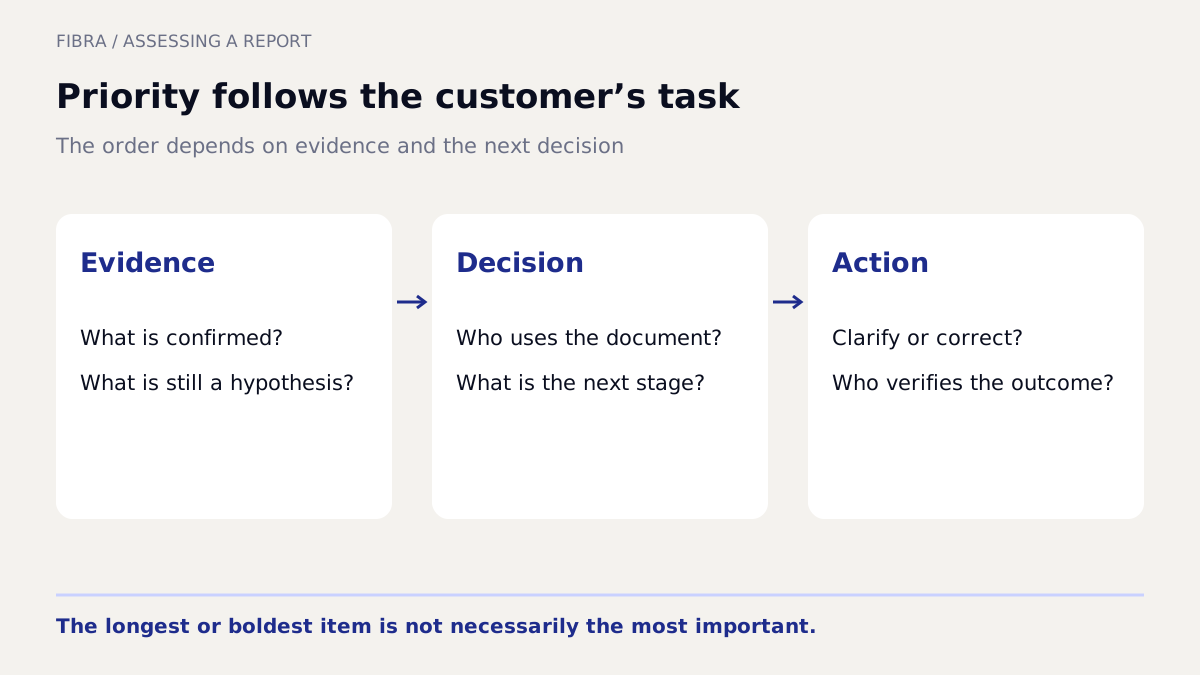
The number of rows does not tell you which question needs resolution first.
5. Obtain a substantive response and verify the correction
A clear finding makes a specific response easier for the designer. The response may contain a corrected revision, a document reference, an explanation of the chosen solution, or a request for missing source information. “Addressed” alone does not say which of those outcomes occurred.
Preserve the connection between the original question and its answer. An ordinary working table can record the number, location, subject, response, corrected revision, and verification outcome. This way of organising work does not assume that the review service provides a built-in approval tracker.
If a correction is made, ask for its location. Then check that place and the related documents. If the quantity changed, return to its original basis; if a designation changed, check the places that use it. A new file with a new date does not confirm that the particular contradiction raised has disappeared.
A sound explanation can resolve a question without changing the design. That is a normal review outcome if the explanation is available and addresses the finding. The goal is not to preserve the AI’s conclusion at any cost. It is to reach a consistent understanding of the documentation.
If information is still insufficient, keep the question open with a clear reason. If the contradiction persists, record that too. Do not mark every item “closed” merely to produce a tidy final list.
In the example at the start, a good conclusion is not a shorter report but a list of independent questions with verified outcomes. For each, it is clear which evidence was checked, what was answered, and which revision accounts for the result. The next person can then use the documents without investigating the entire correspondence again.
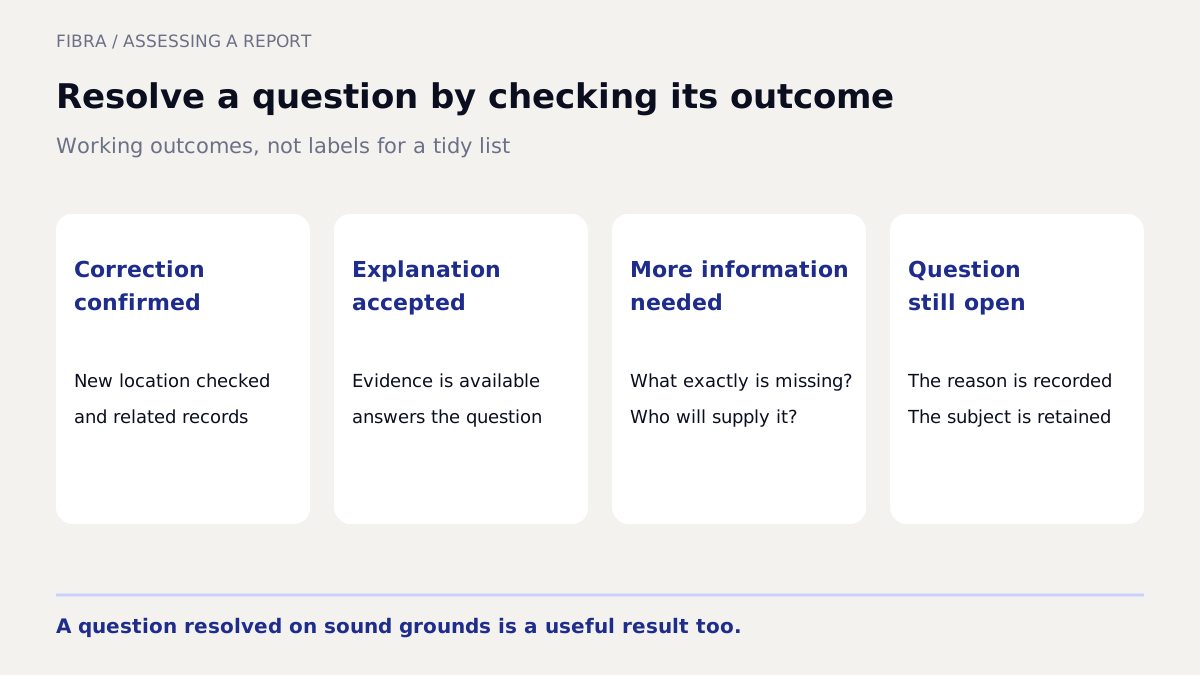
A question resolved on sound grounds is a useful outcome. An unverified “closed” is only a label.
6. How to assess a FIBRA report
Open the FIBRA sample report and choose a few findings to read independently. Check whether you can return to the source location, understand the subject, and assess the evidence. This tells you more about the format’s usefulness than comparing page counts.
Apply the same approach to your own analysis. FIBRA provides an additional review of supplied documents; the report supports subsequent verification and discussion with the designer. It does not transfer acceptance responsibility to the service or guarantee that an absent finding means no possible defects exist.
“A good review” therefore consists of understandable signs: the subject is established, material conclusions have evidence, questions are distinguishable from errors, repetition does not obscure important issues, and responses can be verified. None of those signs reduces to a row counter.
The complete workflow—from choosing a revision to checking responses—is covered in the article about documentation review before acceptance. The main point here is simpler: a useful report makes questions clearer. It does not have to create more of them.
Founder of FIBRA AI