An Extra Digit in the Specification: How an Order-of-Magnitude Error Survives All the Way to the Building Site
A breakdown of real AI findings in one set of design documentation: an area overstated by an order of magnitude, a material named but never ordered, a factor from a note that never reached the quantity. What lies behind each error — and which of them the designers caught on their own.
The specification said 2,192.50 m².
The correct figure is 192.50 m². One extra digit at the front. A single keystroke, and the cladding quantity grew elevenfold.
This isn't a made-up example for an article. It's a line from a real set of design documentation for an industrial facility that we analyzed. And the nastiest thing about it isn't the typo itself — it's how utterly normal it looks.
Regular readers will recognize the number: it opened the very first piece of this cycle — back then our chat assistant read it out politely and saw nothing odd about it. We went back to the same set with a full analysis. What follows is what it turned up besides that one line — and, more to the point, which of those findings the designers fixed without us.
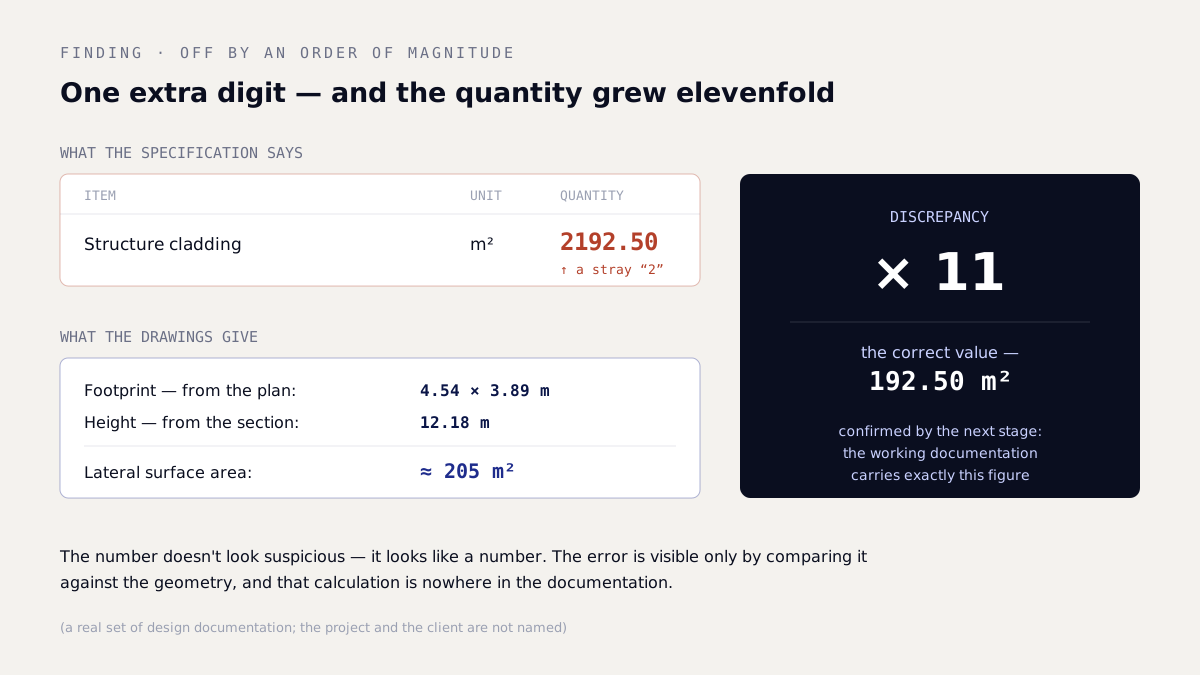
The number doesn't look suspicious. It looks like a number — which is exactly why it survives all the way to procurement.
Why the eye doesn't catch it
Put yourself in the reviewer's chair. In front of you is a materials specification running to several dozen lines. Each one has a description, a unit, a quantity. The numbers span different orders of magnitude: ones, tens, hundreds, thousands. Which of them is wrong?
To answer that, looking at the table isn't enough. You have to step outside it: find the dimensions of the structure on another sheet, take the height off a cross-section, multiply, and compare the result against what's written in the column. For one line that's five minutes. For sixty lines it's a working day — and nobody budgets a working day for a review.
So in practice the check degenerates into a different one: "does this number look about right?" 2,192.50 m² does. It's an area comparable to the façade of a small building. Nothing in the figure itself screams error. The only thing that screams is the comparison with geometry: the structure measures roughly 4.5 × 3.9 metres with a height on the order of twelve — about 205 m² of surface. Between 205 and 2,192 lies a full order of magnitude, but you can only see it by doing a calculation that isn't in the documentation.
This is exactly where the line runs between reading a document and checking a document. We wrote about that line in the piece on why a model never says "I can't see this": reading gives you a retelling, checking demands an independent source. With a specification, the independent source is the geometry of the drawing itself.
What a line like this costs depends on where it gets caught. At procurement it's an extra two thousand square metres of cladding on the order: money, warehouse space, a return to the supplier, and an explanation of why that much was ordered. If it's spotted later, once the material has already arrived, you add logistics and somewhere to keep it all. And if it goes the other way — an understatement, and the same set had cases of that too — the material runs out on site, and that's a crew standing idle. The order of the cost is set not by the error itself but by the stage at which it's found.
What the AI actually does here
Precisely the thing a human doesn't have a working day for: reconciling every line of the table against the place its value ought to be derived from.
The mechanics are deliberately boring. The model doesn't "assess how plausible a number looks" — that road leads straight to invention. It finds the dimensions on the drawings that the quantity is built from, writes them out, and assembles an expression. The expression is then evaluated deterministically — by ordinary arithmetic, not by a neural network. We didn't arrive at that out of choice: language models get three-digit multiplication wrong, and arithmetic cannot be entrusted to them. There'll be a separate article this season on that.
The result is compared against what stands in the column. A discrepancy within rounding is not a finding. A tenfold discrepancy is a finding with an address: here's the sheet, here's the line, here are the dimensions that produce a different number.
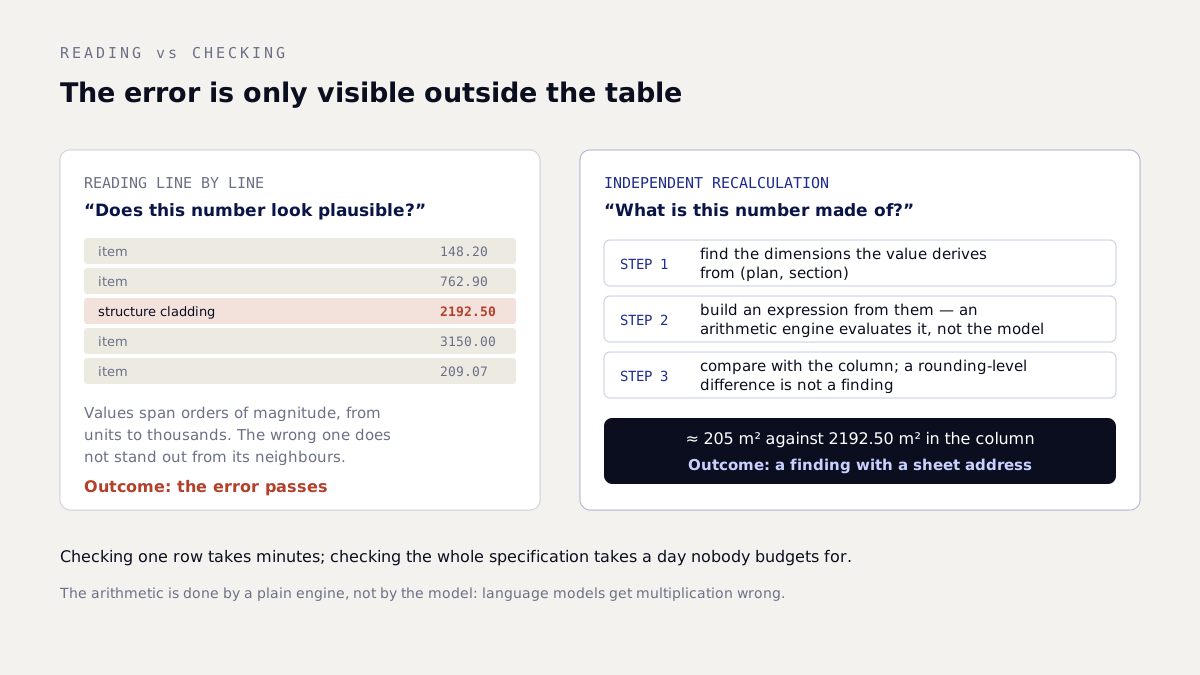
The value in the table isn't eyeballed — it's reconciled against the geometry. That is the difference between reading and checking.
Three other findings from the same set
An order-of-magnitude typo is the most spectacular kind, but not the most typical. The same set turned up several more defects, each of a different shape.
The material is named, but there's nothing to order it by. The build-up of the structure specifies a concrete slab reinforced with steel fibre. The fibre is named, its type given. But there's no quantity — not in that specification, nor in any other across all thirty-four sheets of the set. There is no order line. A contractor working strictly to the documentation simply won't buy the fibre: it doesn't appear in a single item. The error isn't in a number — the error is that no number exists at all.
A requirement in a note never reached the quantity. Under the roofing materials specification sits a note: apply a factor of 1.15 to the consumption rate — an allowance for the overlap between sheets, obvious to any roofer. You lay a roll with an overlap, so you need more material than the bare area of the roof. The specification itself carries that bare area, with no factor applied. The note is written, the requirement is not executed, and the shortfall comes to around 230 m² of material. The roofing crew will hit this on site, not on paper.
One number, replicated across seven items. The roof area in the specification is 763.3 m². But the plan labels three zones: 51.00 + 213.80 + 432.05, which gives 696.85 m², and each of them reproduces exactly against the grid of axes once you allow for the inner face of the parapet. The discrepancy is about 9.5%. On its own that's small; what's unpleasant is something else. Six further items of the specification are calculated from that area, from the roofing membrane to the insulation. One overstated number is replicated across seven order lines.
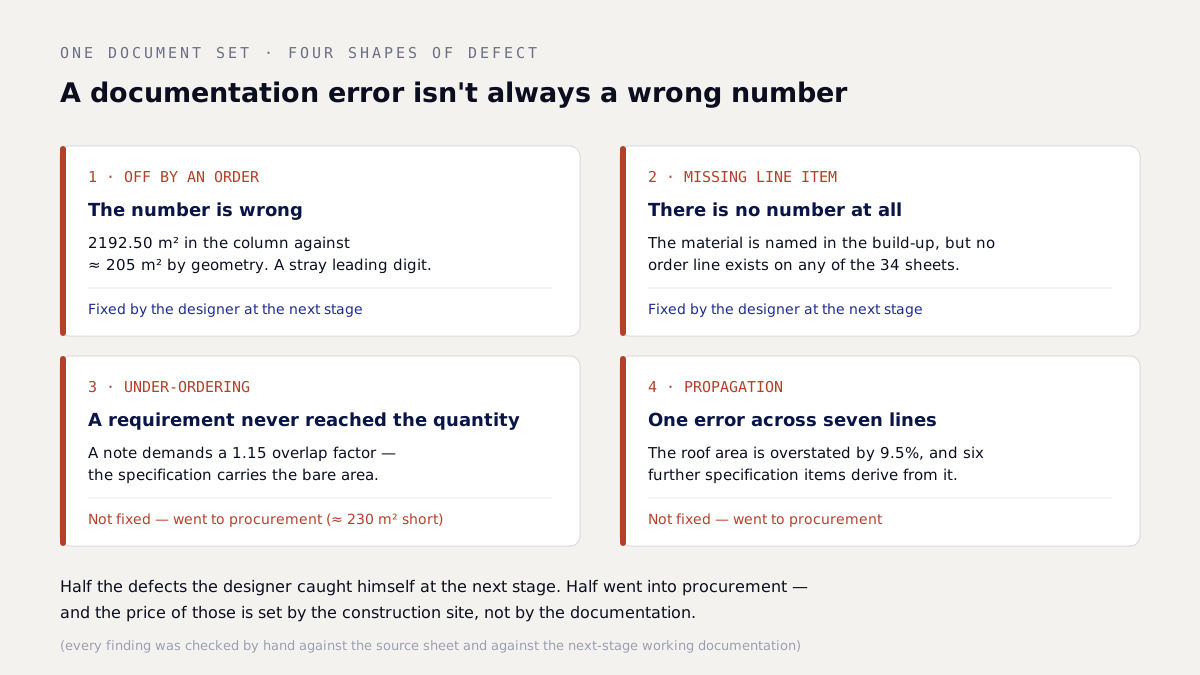
Different mechanisms — and not one of them is caught by reading the document straight through.
The honest part: what got fixed without us
It would be easy to stop here and tot up the money saved. But this story has a second half, and without it the analysis would be dishonest.
We checked every finding against the next stage: the working documentation issued for the same facility later, the set the site actually builds from. The picture turned out to be mixed.
The cladding-area typo the designers caught themselves: the working documentation says 192.50 m². The missing fibre was ordered too — a separate item appeared, with a consumption rate and a quantity. So those two errors never reached the building site, and we "saved" nothing on them.
The 1.15 factor, though, is still not applied — the working documentation carries the same bare area. The overstated roof area carried over unchanged as well, together with all seven dependent items. Those two defects went through to procurement.
The difference between the two halves is time, and nothing else. An error found at the design documentation stage costs an edit in a file. The same error found on site costs a crew standing idle, a repeat delivery, and a conversation with the client about who pays for it. The job of an audit isn't to catch what would be caught anyway — it's to shift the moment of discovery to the left, to the stage where fixing it still costs nothing.
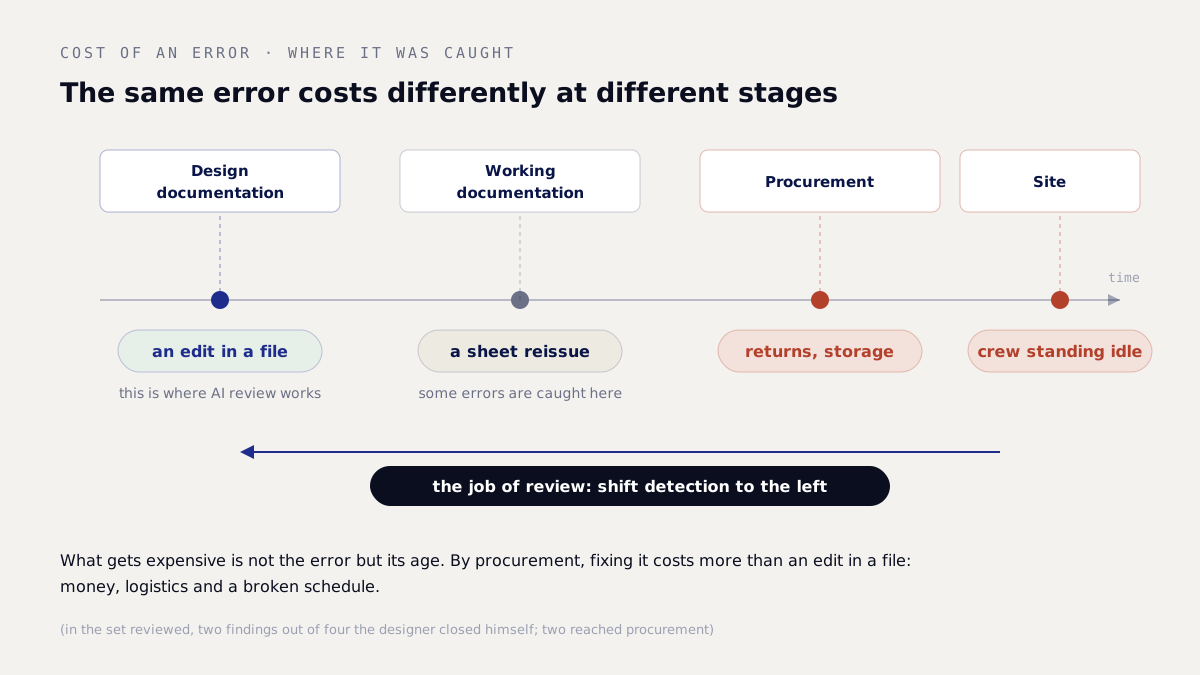
What gets more expensive isn't the error itself but its age. Every stage it passes adds to the cost of the fix.
What we're not claiming
Three caveats, without which the picture would be flattering.
No single run finds everything. The flagship area typo the model found consistently, but some of the subtler discrepancies surfaced in some runs and not in others. That's a property of the technology, not a setting we forgot to switch on — and it means an AI audit complements a human review rather than replacing it.
We verified every finding in this piece by hand. Not "the model said so, therefore it's true": for each one we opened the source and looked at the pixels of the sheet, then cross-checked against the working documentation. Some of the initial findings fell away as false under that scrutiny — that's a normal part of the process, and it's exactly why we insist that every finding must carry an address you can check in a minute.
Finding isn't deciding. The AI shows that a number in the table doesn't reconcile with the geometry. Which of the two values is right, and what exactly to change, is for the designers to decide. The analysis saves hours of searching, but the signature on the project stays human.
What to do about it
The short version: don't count on an error "jumping out at you". It won't — precisely because it looks like an ordinary number in an ordinary table. There is only one way to catch it: by independently recomputing every quantity from the place it is supposed to be derived from.
To see what an analysis with addressed findings looks like in practice, take a look at FIBRA's open demo report — every finding there is tied to a specific place on a sheet. And if you're planning to send a set out for analysis, it's worth running through the documentation readiness checklist first: half of all poor results come down not to the model but to the shape the material was handed to it in.
In the next article: why a single document is worked on by two models rather than one, and why the second of them is deliberately built to argue with the first.
For the technical audience: a couple of clarifications
- "Deterministic calculation" here means literally this: the model assembles an expression from the dimensions it found on the drawing, and an ordinary arithmetic engine evaluates it. What gets checked is not whether the result looks plausible but whether it matches the stated value — with a tolerance for rounding, since otherwise every line in the table would turn into noise.
- Cross-checking against the next stage (the working documentation) isn't part of the product — it's part of our methodology for verifying the findings themselves. It answers the question "was this a real error or a quibble": if the designers fixed the same spot on their own, the finding was real.
- The discrepancy with the first article of the cycle is only apparent. There the height was eyeballed from the above-roof part, which gave an estimate "on the order of 219 m²"; here the dimensions come off the plan and the levels off the section, which yields ≈205 m². It changes nothing about the conclusion: both estimates are an order of magnitude below 2,192.50, and the working documentation later gave 192.50.
- The figures in this analysis are given as they stand; the facility and the client are not named. Material trade names have been replaced with generic ones — we have no complaints about the manufacturers, the defects are in the documentation.